
Engineers and technical teams often face the decision between PFA and FEP when specifying tubing for high-performance systems. Both are fluoropolymers with excellent chemical resistance, smooth flow characteristics and broad temperature capability. Yet each material has its own strengths that make it more suitable for certain applications.
This guide breaks down the differences in a clear and accessible way, helping you choose the right tubing for temperature, purity and mechanical performance requirements.
What PFA and FEP Have in Common
PFA and FEP are both melt-processable fluoropolymers. This means they can be extruded into accurate, consistent tubing with reliable wall thicknesses. They also share several key qualities:
- Long-term chemical resistance
- High electrical insulation values
- Low surface friction
- UV and weathering stability
- Smooth, non-stick internal surfaces
- Strong performance in harsh environments
Because of these similarities, both materials are widely used across chemical processing, laboratory systems, food production and high-purity transfer lines.
Temperature Performance
Temperature capability is where the first major difference appears.
FEP Temperature Rating
FEP performs reliably at continuous temperatures up to roughly 204°C. This makes it suitable for most industrial processes, laboratory duties and general chemical transfer. It also remains flexible at low temperatures, often down to minus 80°C.
PFA Temperature Rating
PFA offers a higher continuous temperature limit of around 260°C. It is also more stable under repeated heating and cooling cycles. As a result, PFA is often the preferred choice for semiconductor work, analytical systems and ultra-clean environments that experience regular heat exposure.
Which should you choose?
- Below 200°C: FEP is usually ideal.
- Above 200°C or with frequent heat cycling: PFA delivers greater stability.
Chemical Resistance
Both PFA and FEP resist a wide range of aggressive substances:
- Acids
- Alkalis
- Organic solvents
- Cleaning agents
- Chlorinated chemicals
- Oxidisers
Their chemical resistance is similar at normal operating temperatures. The difference shows when chemical exposure and high temperature occur together. Under these conditions, PFA often performs better over the long term.
Purity and Extractables
Purity levels matter in environments where contamination must be controlled.
FEP Purity
FEP is clean, stable and suitable for most laboratory and hygienic systems. It maintains clarity, which helps with flow monitoring.
PFA Purity
PFA is the purer of the two, with exceptionally low extractables. It is commonly used in:
- Semiconductors
- Analytical instruments
- Ultra-pure water systems
- High-grade pharmaceutical processes
If a process cannot risk contamination, PFA is usually the primary choice.
Mechanical Strength
PFA offers:
- Higher mechanical strength
- Greater resistance to stress cracking
- Better stability at elevated temperatures
FEP provides:
- Excellent clarity
- Good flexibility
- Stable mechanical performance at moderate temperatures
In applications that involve mechanical stress, bending or handling while hot, PFA has the advantage.
Clarity and Inspection
Clarity is an important deciding factor for engineers who require visual flow monitoring.
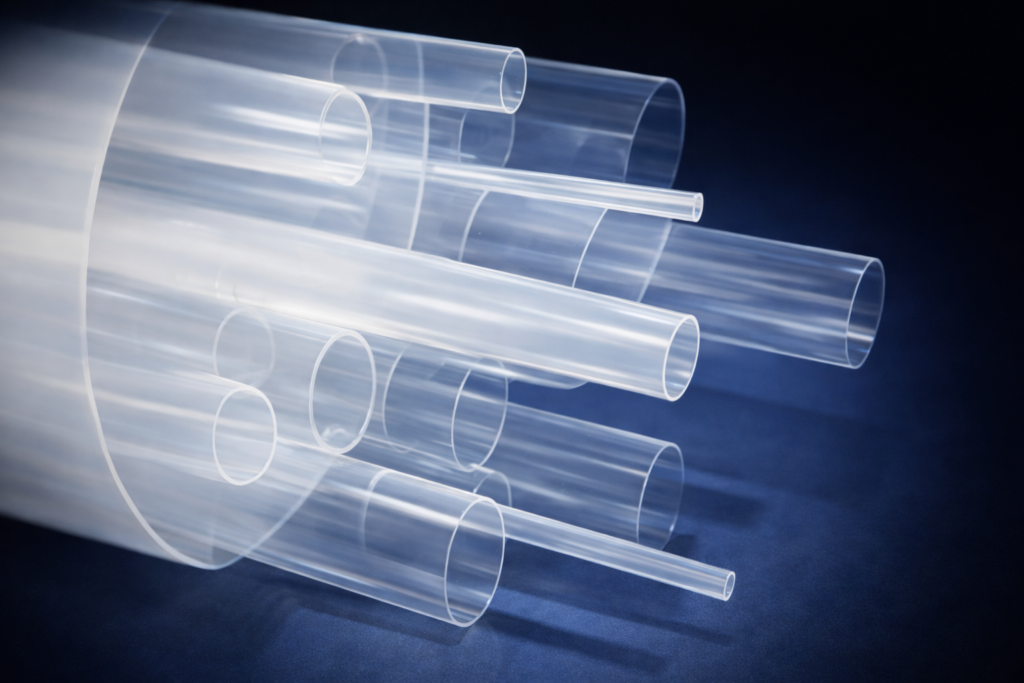
- FEP is one of the clearest fluoropolymers available.
- PFA is translucent but not as visibly clear as FEP.
If visual checking is required, FEP usually becomes the preferred option.
Cost Considerations
PFA is more expensive than FEP. Companies that require its high-temperature and high-purity performance accept this as a necessary part of system reliability.
For general industrial use, FEP provides excellent value while still performing at a very high standard.
UK Applications Where FEP Tubing Is Commonly Used
- Chemical dosing and transfer
- Laboratory equipment
- Food and beverage production
- Water treatment lines
- Marine and outdoor environments
- Electrical insulation
- Any system requiring strong visual clarity
You can explore Holscot’s full FEP tubing range at:
https://holscot.com/products/fluoroplastic-extrusions-fep-teflon-buy-direct/fep-tubing/
UK Applications Where PFA Tubing Is Preferred
- High-temperature chemical delivery
- Ultra-pure processes
- Semiconductor systems
- Analytical laboratory instruments
- Steam and sterilisation environments
- Any process requiring the highest purity levels
You can view Holscot’s PFA tubing range at:
https://holscot.com/products/fluoroplastic-extrusions-fep-teflon-buy-direct/pfa-tubing/
Quick Selection Guide
Choose PFA if:
- Your temperature exceeds 200°C
- Purity is critical
- Tubing will face stress while hot
- Long-term chemical and heat stability are essential
Choose FEP if:
- You need maximum clarity
- Your operating temperature is moderate
- Budget matters
- You need a strong balance of durability and flexibility
Need Help Choosing?
Holscot has specialised in fluoropolymer extrusion for more than sixty years. If you are unsure whether FEP or PFA is the better fit, our technical team can guide you through temperature limits, chemical compatibility and long-term performance in your specific environment.
To discuss your project or explore bespoke tubing options, get in touch with Holscot and we will be happy to support you.