
Ammonia has been produced, moved and stored at industrial scale for more than a century, largely as fertiliser feedstock, and that long history makes ammonia storage look like a settled question. It is not. What ammonia is now being asked to do has changed considerably, and the containment has not always kept pace. Ammonia is being specified as a marine fuel, as a carrier for shipping hydrogen internationally, and as a means of holding renewable energy in chemical form until it is needed. Each of those roles puts the product into smaller vessels, more frequent transfer cycles and a far wider spread of operators than the fertiliser industry ever had to accommodate.
When that happens, containment stops being background infrastructure and becomes one of the factors that decides whether a project is viable at all. Material selection is where that decision is made. This article looks at what ammonia does to the materials around it, why conventional answers become disproportionately expensive at smaller scales, and where a flexible fluoropolymer barrier changes the shape of the problem entirely.
Why Ammonia Storage Is a Harder Problem Than It Looks
Three developments have moved ammonia up the agenda, and each one pulls the containment requirement in a different direction.
The first is shipping. Decarbonisation targets set by the International Maritime Organization have left shipowners searching for a fuel that can be produced without fossil carbon and burned without releasing carbon dioxide. Ammonia meets that description because the molecule contains no carbon at all. Engine designs exist, bunkering trials have taken place at several ports, and the fuel is now being planned into vessel newbuilds rather than discussed in the abstract.
The second is hydrogen. Hydrogen itself is difficult to move, requiring either very high compression or cooling to around minus 253 degrees Celsius. Ammonia liquefies at minus 33 degrees Celsius at atmospheric pressure, or at roughly eight to ten bar at normal ambient temperature, and carries approximately 17.6 per cent hydrogen by mass. That combination makes it a considerably more practical carrier, which is why much of the current interest in ammonia for hydrogen storage originates with energy companies rather than chemical producers.
The third is scale. Traditional ammonia storage is very large indeed. A refrigerated terminal tank at a fertiliser facility holds tens of thousands of tonnes, is built once on a prepared site, and has a design life measured in decades. The emerging applications need something quite different: modular, transportable, sometimes single use, and often built for a duty cycle that has no established precedent. Design conventions written around a 50,000 tonne tank do not scale down neatly, and the assumptions embedded in them are rarely stated explicitly enough for anyone to know which ones have stopped applying.
What Ammonia Does to Conventional Materials
Ammonia is not aggressive in the way a strong mineral acid is. It is aggressive selectively, and that is precisely what catches specifiers out, because a material that performs perfectly well in one part of a plant can fail quickly in ammonia service.
Copper is the clearest example. Ammonia attacks copper and copper alloys readily, which rules out brass fittings, bronze valve components and copper tube entirely. This is thoroughly understood within industrial refrigeration, where ammonia systems are built in steel precisely because copper cannot be used, but it continues to cause problems whenever equipment is repurposed from another duty and the original material specification is not revisited. Zinc and its alloys present the same difficulty, so galvanised components are not a safe substitute.
Carbon steel is the traditional material for an ammonia storage tank and it does work, but with a qualification that has been the subject of decades of investigation. Anhydrous ammonia can cause stress corrosion cracking in carbon steel, particularly at welds where residual stresses have not been relieved and where the ammonia carries traces of dissolved oxygen. The established mitigation is to maintain a small quantity of water in the ammonia, typically around 0.2 per cent, which acts as an inhibitor. That approach is effective, but it means the stored product is deliberately not pure. For fertiliser use that is immaterial. For a fuel entering a marine engine, or a feedstock going into a cracker to release hydrogen, purity becomes a genuine constraint rather than a preference.
Soft materials deserve equal attention. Ammonia swells and degrades many common elastomers, so gasket, seal and hose selections that would be entirely unremarkable elsewhere fail quickly in this service. The pattern is familiar to anyone who has had to account for an unplanned shutdown traced back to a seal specified from a generic compatibility chart. Ammonia corrosion problems are rarely dramatic. They are slow, selective and frequently invisible until something leaks, and ammonia is not a substance where leaks are tolerable.
Ammonia Storage Conditions and What They Demand of the Containment
There are broadly three regimes in which ammonia is held, and each loads the containment differently.
Fully refrigerated storage holds ammonia at around minus 33 degrees Celsius at close to atmospheric pressure. The vessel does not need to be a pressure vessel, which simplifies the structure considerably, but every material in contact with the product must remain serviceable at that temperature and the tank must tolerate the thermal cycling that comes with filling and emptying. Pressurised ambient storage takes the opposite approach, keeping ammonia liquid at roughly eight to ten bar at whatever temperature the surroundings happen to provide. This is how smaller volumes are usually handled, and it removes the refrigeration plant at the cost of introducing pressure containment. On a hot day the internal pressure climbs further, and the design has to account for that. Semi-refrigerated storage sits between the two, combining moderate pressure with moderate cooling, and is common on transport vessels.
Whichever route is chosen, the ammonia storage temperature and pressure regime is not static. It moves with ambient conditions, with the fill level and with the operating cycle, and the barrier between the product and the outside world has to move with it without cracking, embrittling or losing adhesion to whatever it is protecting. Ammonia storage requirements that address only the steady state condition tend to underestimate what the containment is actually being asked to survive.
The Properties That Make FEP Suited to Ammonia Service
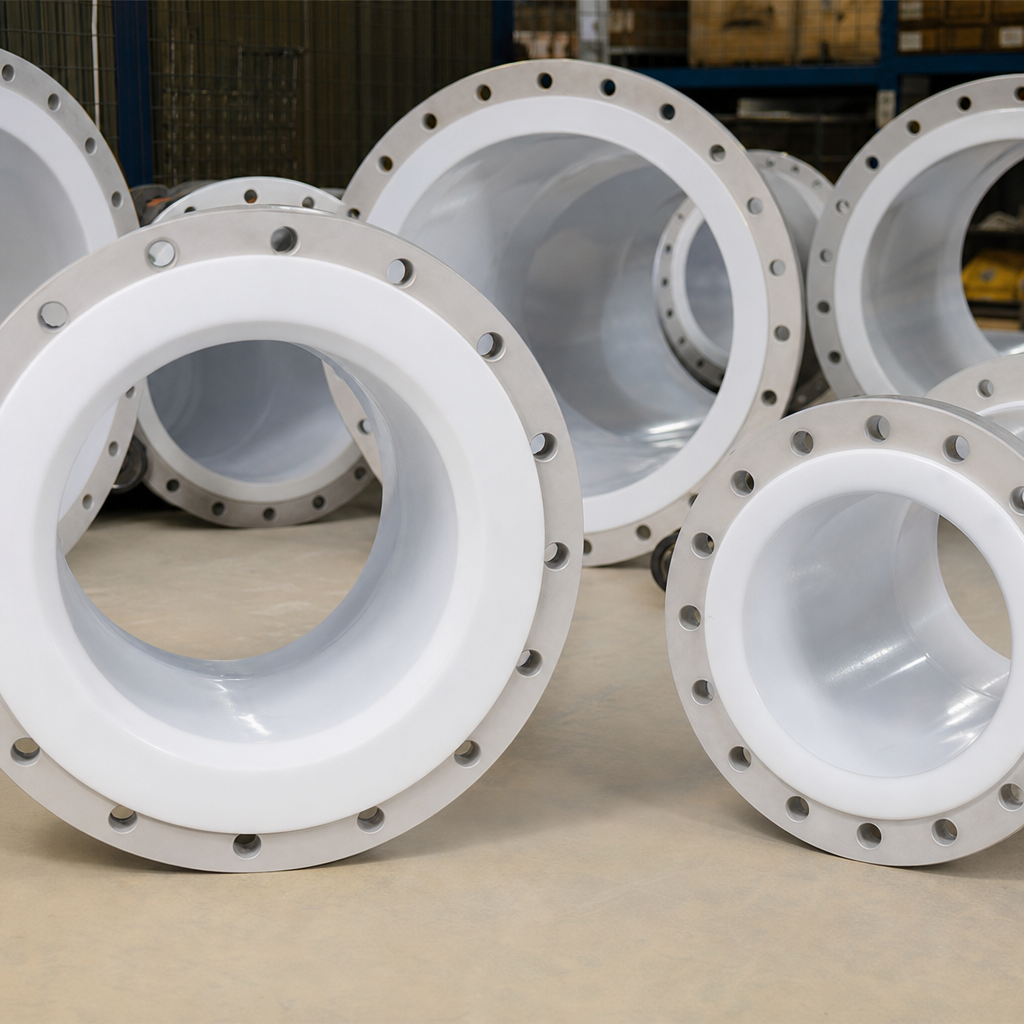
FEP, or fluorinated ethylene propylene, belongs to a family of fluoropolymers whose defining characteristic is that almost nothing reacts with them. The carbon to fluorine bond is among the strongest in organic chemistry, and a polymer built around it is close to chemically inert. FEP is unaffected by ammonia, and unaffected by the large majority of acids, alkalis and solvents as well. The comparison between the different fluoropolymers is set out in more detail in Holscot’s guide to chemical resistant tubing for harsh environments, and each polymer is explained in plain language in the fluoropolymer glossary.
For ammonia duty specifically, four properties carry most of the weight. Fluoropolymers do not stress corrosion crack, because they have no crystalline metallic structure for a crack to propagate through in the way carbon steel does, which removes the failure mechanism that drives so much conventional ammonia tank design. FEP remains flexible and serviceable from cryogenic temperatures up to around 200 degrees Celsius continuous, which covers refrigerated ammonia at minus 33 degrees with a substantial margin at both ends of the range. Nothing leaches out of the polymer and nothing reacts with it, so ammonia stored behind an FEP barrier remains as pure as it was when it entered, removing the need to trade purity against corrosion protection. And FEP is flexible, which is the property that opens up designs a rigid vessel cannot reach at all.
Flexible FEP Bag Liners and Dip Pipes
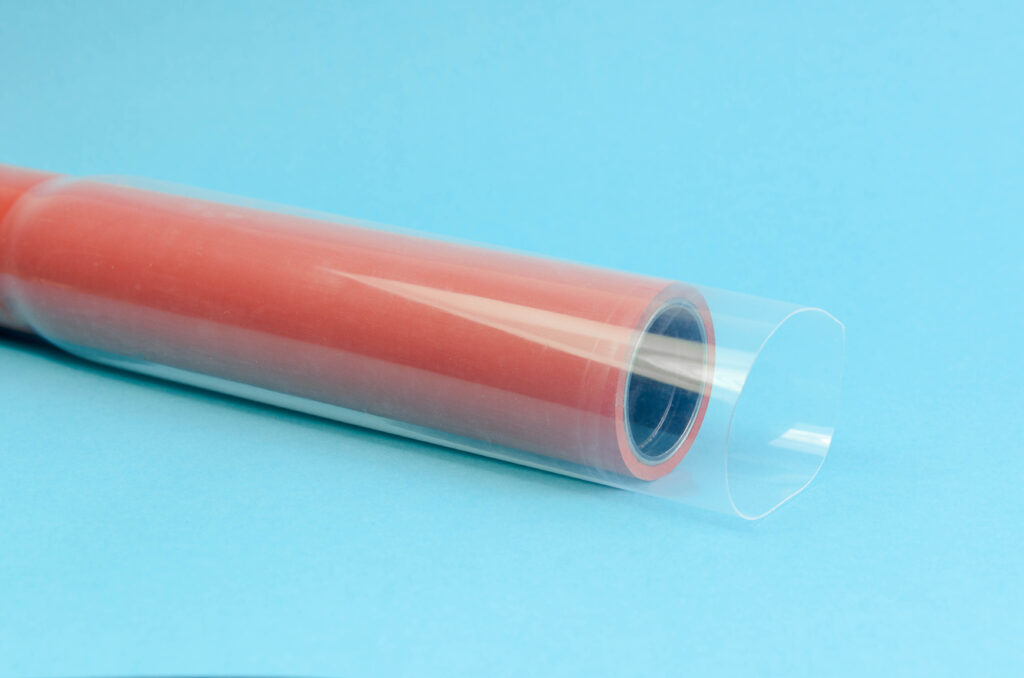
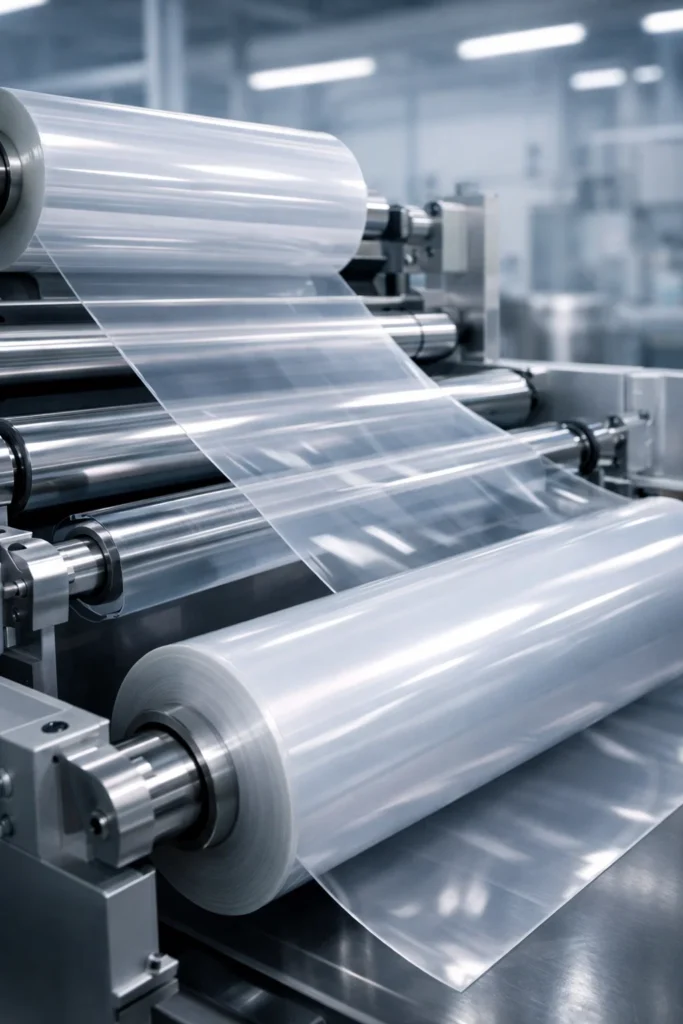
Holscot offers flexible FEP solutions that can operate in liquid to air applications. Using our expertise in welding fluoropolymer seams of the same material are fused together, and therefore these offer the same chemical resistance as the film either side of it.
Scaling the principle is a manufacturing question rather than a chemistry question. The chemistry does not change with volume. What changes is the size of the film, the length of the welds and the complexity of the fabrication, and those are engineering problems with established answers.
Holscot are the industry experts for welded film, chemical containment & FEP.
Scaling the Principle for Sub-Sea Deployment
Sub-sea storage of liquid ammonia is where this becomes genuinely interesting, and the reasoning is worth setting out properly rather than asserting.
The seabed provides a stable low temperature environment without any refrigeration plant, removing both the capital cost and the parasitic energy load that refrigerated storage carries. It provides hydrostatic pressure acting on the outside of a flexible container rather than against it, which is a fundamentally different structural problem from a pressure vessel resisting internal pressure and a considerably easier one to solve with a flexible barrier. It places storage close to offshore wind generation, where surplus electricity is the input to green ammonia production in the first place, shortening the chain between generation and storage. And it removes both the land footprint and the population proximity questions that make onshore ammonia storage difficult to permit in many jurisdictions.
None of that works well with a rigid steel tank, which has to be engineered to resist external pressure, protected against seawater corrosion on the outside and ammonia attack on the inside, and then inspected in place at depth. A fluoropolymer solution suits the environment far better, because it is inert to the ammonia inside and to the seawater outside, and because it works with the hydrostatic pressure rather than against it.
Holscot already supplies the offshore sector with corrosion resistant lined pipework and umbilical liners, so the marine environment is established territory rather than a new departure. That work is set out on the offshore industry page, and the wider energy transition applications appear on the green technologies page.
The Role of Manufacturing Capability in Bespoke Containment
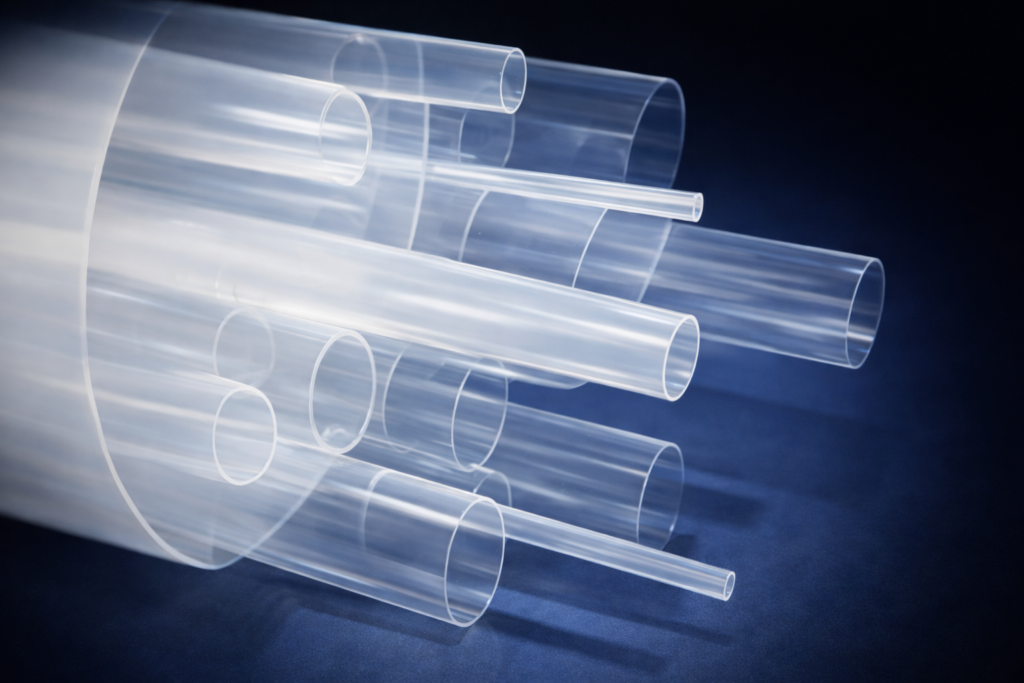
Large format flexible containment is only a realistic proposition where the manufacturing route is under one roof. Holscot operates eight extrusion lines in the UK producing fluoropolymer tube from 3mm to 400mm in diameter, and welds and fabricates fluoropolymer products in house rather than buying in finished sections from a converter. That control over the full route from resin to finished assembly is what determines whether a bespoke bag is a product or a research project, because it means geometries can be set by the application rather than by what happens to be available.
It also matters for the development stage. A concept that requires several iterations of geometry before it settles is expensive and slow when every iteration goes out to a third party, and manageable when the extrusion and fabrication capability sits alongside the engineering.
Sub-sea ammonia storage is at the point where the materials science is settled and the engineering development needs funding behind it. The principle is proven at small scale, the manufacturing capability exists, and the application is real rather than speculative. What it requires now is a partner with a commercial reason to take it to scale. Organisations working on green ammonia, marine fuel bunkering, seabed energy storage or hydrogen carrier infrastructure, with development funding in place, are invited to make contact through the contact page. Smaller ammonia and chemical containment problems, where a fluoropolymer barrier would solve something a metal one cannot, are equally welcome.
Frequently Asked Questions
What temperature is ammonia stored at?
Fully refrigerated ammonia is held at around minus 33 degrees Celsius at close to atmospheric pressure, which is its boiling point. Pressurised storage keeps ammonia liquid at ambient temperature by holding it at roughly eight to ten bar instead. Semi-refrigerated storage combines moderate cooling with moderate pressure and is common on transport vessels. The route chosen determines what the containment materials have to tolerate.
What are the requirements for ammonia storage?
Ammonia storage requirements cover the vessel itself, the materials in contact with the product, leak detection, ventilation and emergency response. Materially, the critical requirements are that no copper, brass, bronze or zinc alloy comes into contact with the ammonia, that carbon steel components are stress relieved and protected against stress corrosion cracking, and that every seal and flexible component is verified as compatible with ammonia rather than assumed to be.
Is ammonia corrosive to metal?
Ammonia is highly corrosive to copper and copper alloys, and to zinc and galvanised surfaces, which rules those materials out of ammonia service entirely. It is less aggressive towards carbon steel and stainless steel, but anhydrous ammonia can cause stress corrosion cracking in carbon steel, particularly at welds and where dissolved oxygen is present. Fluoropolymers such as FEP and PFA are unaffected by ammonia across the full temperature range in which it is handled.
How is liquid ammonia transported?
Liquid ammonia moves by pipeline, road tanker, rail tank car and ship. Smaller volumes travel pressurised at ambient temperature, while bulk cargoes are usually carried fully or semi refrigerated. The material constraints on transport are the same as those on static storage, with the additional factor that transport containers see far more fill and discharge cycles, so fatigue and thermal cycling carry more weight in the design.
Can ammonia be used to store hydrogen?
Yes, and it is among the more practical methods available. Ammonia contains around 17.6 per cent hydrogen by mass and liquefies under far milder conditions than hydrogen itself, so it can be stored and shipped using established liquid handling infrastructure. The hydrogen is then released by cracking the ammonia at the point of use. The trade off is the energy cost of synthesising the ammonia and cracking it again, which is why the efficiency of every stage in between, storage included, matters commercially.