
Ask ten engineers what counts as a heat resistant plastic and you will get ten different answers. A kitchen utensil that survives boiling water is heat resistant in one sense. A sleeve on a roller running at 200°C, day in and day out, is something else entirely.
This guide sets out what heat resistance really means for plastics, how the common grades compare, and which materials keep working once temperatures climb past 200°C. We cover the everyday plastics most people meet first, the high performance engineering grades, and the fluoropolymers that we have been extruding and fitting at Holscot in Grantham since 1970.
The aim is simple. By the end you should be able to look at a hot application, work out roughly which family of materials will survive it, and know which questions to ask before you commit to a design. That matters, because the wrong plastic in a hot spot rarely fails gently. It softens, creeps, cracks or gives off fumes, and the cost of finding out the hard way is usually far higher than the material itself.
Which Plastics Can Withstand High Temperatures?
Plenty of plastics can cope with short spells of heat, but only a small group can work continuously above 150°C. These are the high performance engineering plastics, such as PEEK and polyimide, and the fluoropolymers, including PTFE, PFA and FEP. Everyday plastics such as PVC, acrylic and polyethylene start to soften well below the boiling point of water or not far above it.
Melting point is not the number that matters
Most people search for a plastic’s melting point, and it is a useful figure, but it is rarely the limit you design to. Long before a thermoplastic melts it softens, loses stiffness and starts to deform under load. A part can be ruined at temperatures far below its melting point.
Some plastics do not have a sharp melting point at all. Amorphous plastics such as acrylic and polycarbonate soften gradually over a range, which is why they sag and bend before they ever turn liquid.
Continuous service temperature and heat deflection
The figure that matters most is the continuous service temperature. This is the highest temperature a material can sit at for long periods while keeping most of its useful properties. For heat resistant plastic selection it is the first number to check.
The second is the heat deflection temperature, which shows when a plastic starts to bend under a set load. It is a good guide for structural parts. A sleeve, liner or film carries little load, so for those products the continuous service temperature tells you more.
Does plastic melt at 100°C?
Some plastics do start to soften at 100°C. Low density polyethylene melts at not much more than that, and PVC and acrylic are already soft well before boiling point. Polypropylene and high density polyethylene hold their shape a little longer, but they will not take sustained heat much above 100°C.
That is why heat resistant plastic material is a specialist area. Once a process runs hotter than boiling water, most of the plastics found in packaging and household goods are out of the running.
Heat Resistant Plastic Compared, From Everyday Grades to Fluoropolymers
The figures below are typical continuous service temperatures. Exact values vary by grade, additives and how the part is loaded, so treat them as a starting point rather than a specification.
Everyday plastics: PVC, acrylic, polyethylene and polypropylene
- PVC: around 60°C
- Acrylic: around 70 to 80°C
- Polyethylene: around 80°C
- Polypropylene: around 100°C
These are cheap, easy to process and perfectly good for most consumer and building products. They are not suitable for hot process equipment, and none of them would be described as a heat proof plastic.
Polycarbonate and nylon
Polycarbonate can be used continuously at around 115 to 125°C, which makes it noticeably more heat resistant than acrylic. If you are choosing between the two for a hot environment, polycarbonate is the better option, although it has weaker chemical resistance and will scratch more easily.
Nylon sits in a similar bracket for continuous use, with grades typically rated at around 80 to 120°C. It is tough and wear resistant, but it absorbs moisture, which changes its size and strength.
High performance engineering plastics
Above this level you move into a smaller, more expensive group. PEI is usually rated to about 170°C, PPS to around 220°C, and PEEK to about 250°C. Polyimide is one of the most heat resistant plastics of all, with some grades used continuously at 300°C.
These materials are strong and stiff at temperature, which makes them ideal for machined structural parts. Their weakness is cost, and some of them are not as chemically resistant as you might expect.
Fluoropolymers: PTFE, PFA, FEP, ETFE and PVDF
- PTFE: around 260°C
- PFA: around 260°C
- FEP: around 200°C
- ETFE: around 150°C
- PVDF: around 150°C
What sets fluoropolymers apart is that they combine high heat resistance with near total chemical resistance and a non-stick surface. PEEK may match PFA on temperature, but it will not shrug off the same range of acids and solvents. For a full comparison of the main grades, see our fluoropolymer material selection guide.
Which Plastic Does Not Melt?
PTFE does not melt in the usual sense. It reaches its melting point at around 327°C, but it becomes a stiff gel rather than a liquid, so it cannot be poured or injection moulded. That is why PTFE parts are pressed and sintered, and why melt processable fluoropolymers such as FEP and PFA were developed.
Thermosets, such as phenolic and epoxy resins, do not melt either. Once they have cured they will char and break down if overheated, but they never soften and flow again. Polyimide behaves in a similar way and keeps its form at temperatures that would destroy most other plastics.
What plastic can withstand 300 degrees?
Very few plastics can work at 300°C. Some polyimide grades can, and PEEK, PTFE and PFA can handle short periods close to it. For continuous use above about 260°C, metals, ceramics or glass are usually the safer choice.
PFA is often the best compromise just below that limit. It keeps its chemical resistance and non-stick surface right up to around 260°C, and it can be extruded, heat shrunk and formed, which PTFE cannot.
What is the best heat proof material?
No plastic is truly heat proof. Every polymer has a point where it softens, degrades or burns. If a part has to survive several hundred degrees, a ceramic, metal or glass is the right answer.
Where plastics come into their own is the band from roughly 150°C to 260°C, especially when heat comes with chemicals, moisture or sticky product. That is the band where fluoropolymers do their best work.
Why Fluoropolymers Make Sense in Hot, Harsh Service
Heat and chemicals together
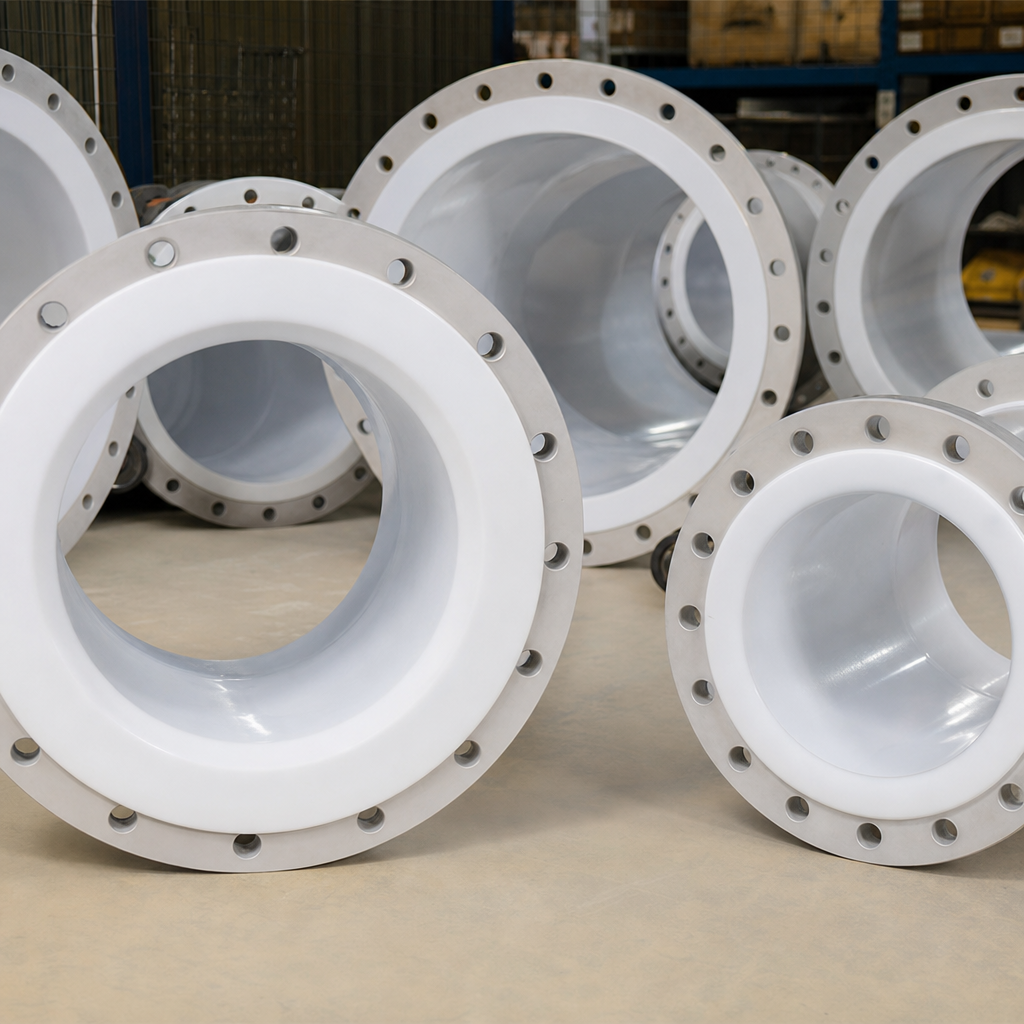
Heat speeds up chemical attack. A plastic that copes with an acid at room temperature may fail quickly when the same acid is at 150°C. PFA and FEP keep their chemical resistance across their full temperature range, which is why we line hot chemical equipment with them.
One example is flue gas desulphurisation, where the fumes passing through a heat exchanger can run at over 200°C and are highly corrosive. Covering the coolant bars and internal structure in PFA protects the metal far better than bare steel or most other plastics could.
Non-stick surfaces that stay non-stick
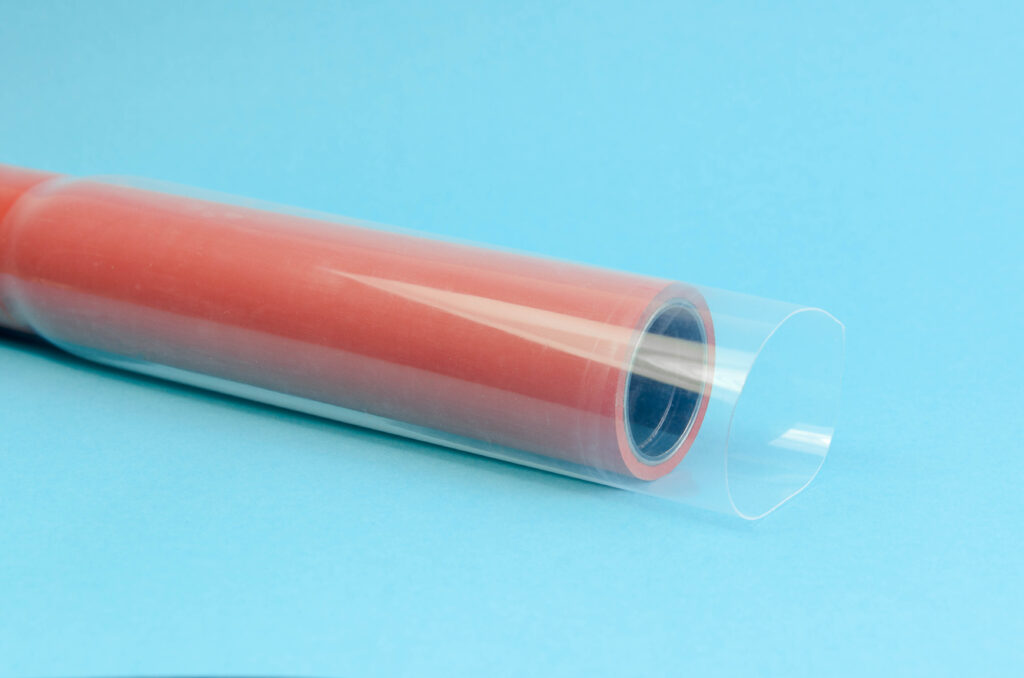
Many hot processes involve something sticky, such as adhesive, ink, resin or food. Fluoropolymers keep their low friction, non-stick surface at temperature. That is why heated rollers in printing, coating and food lines are covered with FEP or PFA. Our heat shrink sleeving is shrunk tightly onto the roller, giving a hard wearing release surface that can be replaced without stripping the roller back.
Cold as well as heat
The same materials perform at the other end of the scale. PTFE, FEP and PFA stay flexible at very low temperatures, which few other plastics can claim. That makes them useful in cryogenic equipment and in space, where parts can swing between extremes.
Fire behaviour
PTFE, FEP and PFA are very hard to ignite and will not keep burning in normal air once the flame is removed. This is one reason they are used for wire insulation in aircraft and other places where fire risk must be kept to a minimum.
Choosing a Heat Resistant Plastic Material for Your Application
Work out the real temperature
Start with the highest temperature the part will see in normal running, then add the peaks. Start-up, cleaning cycles and fault conditions can all push temperatures above the usual figure. Choose a material whose continuous service temperature sits comfortably above your normal running temperature, not just level with it.
Allow for expansion and creep
Plastics expand far more than metals when they heat up, and fluoropolymers expand more than most. A liner or sleeve has to be designed to cope with that movement. Under load, plastics also creep, slowly deforming over time, and creep gets worse as temperature rises.
Think about how the part will be made
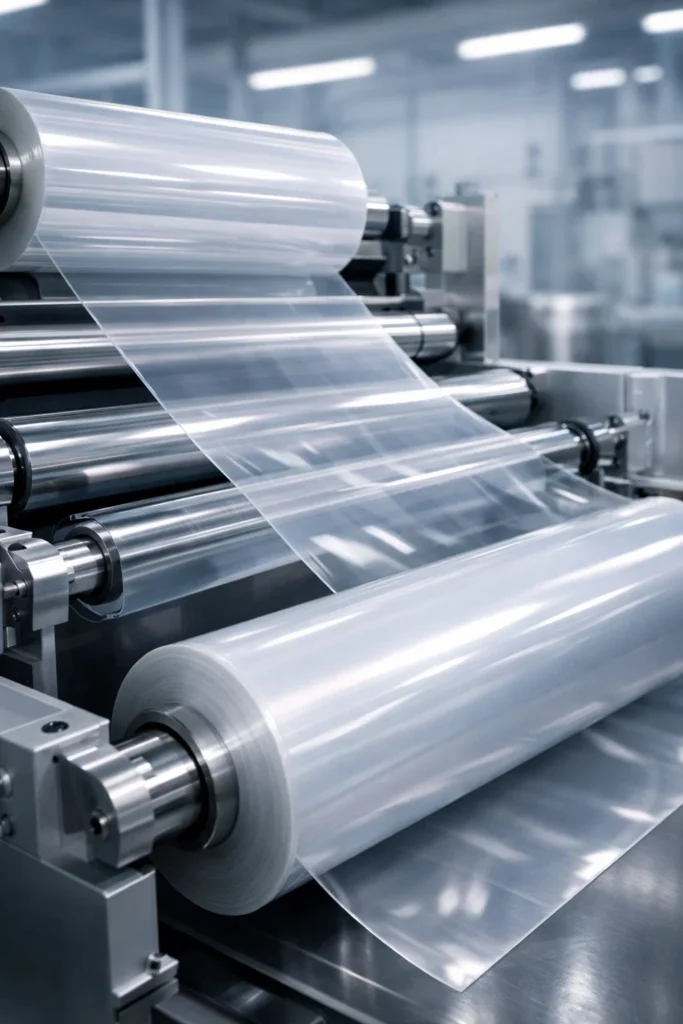
The best material on paper is no use if it cannot be made into the shape you need. PTFE has superb heat resistance but cannot be melt extruded or heat shrunk. If you need tubing, sleeves or thin film for a hot application, PFA or FEP is usually the practical choice. Our PFA heat shrink sleeving is made for exactly these higher temperature duties.
Stay within safe limits
Every plastic has an upper limit, and fluoropolymers are no exception. If PTFE or other fluoropolymers are heated well beyond their rated temperatures, for example during welding or a fire, they can break down and give off harmful fumes. Keep within the rated service temperature, and make sure any welding or forming work is done with proper extraction.
Frequently Asked Questions
What temperature does plastic melt?
It depends entirely on the plastic. Low density polyethylene melts at a little over 100°C, polypropylene at around 160°C and nylon at around 220 to 260°C. Fluoropolymers melt much higher, with FEP at around 260°C, PFA at around 305°C and PTFE at around 327°C.
Remember that most plastics soften and lose strength well before they reach their melting point. For design work, use the continuous service temperature rather than the melting point.
Is PVC heat resistant?
No, not in any industrial sense. Rigid PVC is usually limited to about 60°C in continuous use and starts to soften not far above that. Hot water at around 80°C can be enough to distort PVC pipe.
PVC is a sound choice for cold water, drainage and many chemical duties at room temperature. For anything hotter, a higher grade such as polypropylene, PVDF or a fluoropolymer lining is needed.
Is polycarbonate heat resistant?
Polycarbonate is more heat resistant than most everyday plastics, with continuous use typically rated at around 115 to 125°C. It keeps its toughness well, which is why it is used for guards and covers.
It is not suitable for sustained temperatures much above that, and it can be damaged by some solvents and by long exposure to hot water. For higher temperatures or harsh chemicals, a fluoropolymer is the safer choice.
What is the cheapest heat resistant plastic?
Polypropylene is usually the cheapest plastic that copes with boiling water, and it is a common choice for hot water and kitchenware up to around 100°C. Above that, costs rise quickly as you move into nylon, PPS and then PEEK and the fluoropolymers.
The cheapest material is not always the cheapest choice. A part that fails early in a hot, chemical process costs far more in downtime than a better grade would have cost at the start.
Talk to Holscot About Your Hot Application
A heat resistant plastic is only as good as its continuous service temperature, and that figure falls well short of the melting point for most materials. Everyday plastics stop at around 100°C. Engineering grades such as PEEK and polyimide go much further, and fluoropolymers add chemical resistance and a non-stick surface right up to around 260°C.
If you are dealing with a hot process, a failing liner or a roller that keeps sticking, we can help you choose between FEP, PFA and ETFE and make the part to suit. Browse our fluoroplastic extrusions and film and sheet, or contact the Holscot team to talk through your application.