Why Fluoropolymer Tank Linings Are Essential in Corrosive Service
Industrial tanks, vessels and associated process equipment are expensive assets, but in corrosive environments they can become vulnerable surprisingly quickly if the wrong materials are in contact with the media inside them. Corrosion is not only a maintenance issue. It threatens service life, product quality, operational safety and confidence in the whole process system. That is why fluoropolymer tank linings remain such an important solution in chemical and industrial handling applications.
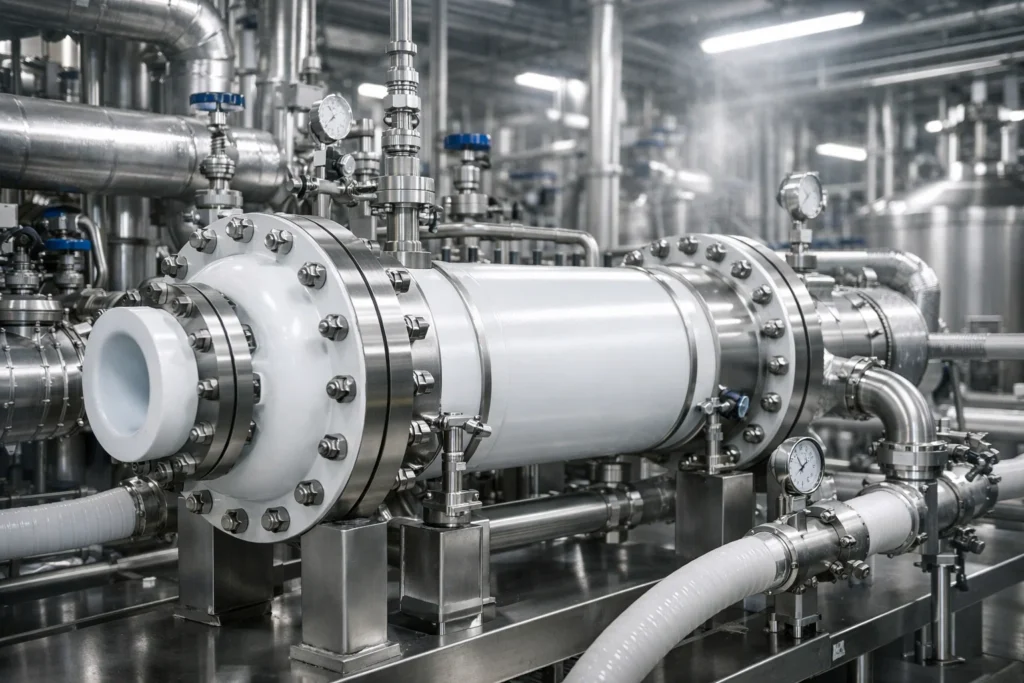
The basic purpose of a fluoropolymer lining is to protect the structural body of a tank or vessel from media that would otherwise attack it. Instead of relying entirely on the corrosion resistance of the substrate, the system introduces a fluoropolymer barrier between the stored chemical and the equipment wall. For many aggressive duties, this is one of the most practical ways to combine structural strength with chemical resilience.
Fluoropolymers such as PTFE, PFA and FEP are particularly attractive because they are highly resistant to a broad range of chemicals and remain stable in demanding process environments. Depending on the application, the lining may also offer smooth surfaces that reduce product adhesion, support easier cleaning and lower the risk of contamination or difficult residue build up.
Where Tank Linings Are Used and Why
Tank linings are relevant across a wide range of sectors. Chemical processing is the obvious one, but the same logic applies anywhere aggressive media must be stored, transferred or handled safely. That may include specialist manufacturing, waste treatment, process intermediate storage and containment systems where the media is too severe for unprotected steel or other common construction materials.
One of the reasons fluoropolymer linings are so valuable is that they allow engineers to avoid the false choice between corrosion resistance and practical construction. Building an entire vessel from an exotic material may be prohibitively expensive or mechanically unnecessary. Lining allows the vessel to retain a suitable structural shell while the process side is protected by a material chosen specifically for chemical compatibility.
The choice between PTFE, PFA and FEP depends on the service conditions. PTFE is widely known for broad chemical resistance and high temperature capability. PFA often enters the frame where melt processability, cleanability and demanding chemical service are important. FEP can offer an effective balance of chemical resistance and fabrication advantages in the right applications. The best answer depends on media, temperature, mechanical conditions and the specific lining method being used.
Lining Methods and Design Considerations
Lining method itself is a key part of the discussion. There is no single universal way to line a tank. Depending on the vessel geometry, duty and fluoropolymer involved, options may include loose lining, welding, or other fabrication strategies suited to the application. The chosen method has to support both chemical performance and long term integrity.
Loose lining can be useful in certain vessel applications where a separate fluoropolymer liner is installed within the structural shell. This can provide effective chemical isolation while allowing the outer body to carry the mechanical load. Welded fluoropolymer constructions may suit other geometries or systems, especially where continuity and tailored fabrication are required. The important point is that lining design and installation are engineering decisions, not generic add ons.
Inspection and lifecycle planning matter too. A good lining system should not simply be installed and forgotten. Operators need a sensible approach to inspection, maintenance and expected service life. The exact regime depends on the process, but the principle is consistent: lining is there to extend asset life and reduce risk, and that value is strongest when condition is monitored intelligently.
Service Life, Contamination Control and Maintenance Benefits
Service life can be one of the most compelling arguments for fluoropolymer tank linings. In corrosive duties, unlined systems may require repeated intervention, patching or premature replacement. Over time, this can make the apparently cheaper option far more expensive. A properly specified lining can improve reliability, reduce shutdown risk and deliver better whole life economics.
There is also a contamination angle. In some processes, corrosion products or degraded surfaces are not just a maintenance nuisance. They affect product quality or downstream equipment performance. A stable fluoropolymer barrier helps preserve a more controlled process environment. Where the process fluid must remain clean, that can be crucial.
Another benefit is maintenance predictability. Corrosion often becomes expensive not because it exists, but because it progresses unevenly and reveals itself at inconvenient moments. Lined systems can support more stable operation by reducing the likelihood of sudden deterioration in critical wetted areas. In plants where uptime matters, that stability has real operational value.
Specification and Supplier Expertise
For engineers specifying or upgrading containment systems, early material review is essential. Questions to ask include the nature of the chemical, concentration, operating temperature, tank geometry, cleaning procedures and what the consequences of failure would be. Is the priority preventing corrosion, preserving purity, supporting easier cleaning or all three? A fluoropolymer lining makes most sense when those priorities are explicit.
Holscot’s wider capability in fluoropolymer containment, film, lining and custom fabrication is relevant here because tank lining projects often require more than a standard material supply. Dimensions, geometry, process conditions and fabrication details all shape the final solution. In harsh chemical service, that practical fluoropolymer know how matters as much as the base material choice.
Holscot’s experience with fluoropolymer solutions for chemical processing provides further context on how these materials are applied in real industrial environments.
The reason fluoropolymer tank linings remain so widely respected is that they solve an old industrial problem with a sophisticated but practical approach. Instead of fighting corrosion after the fact, they prevent the media from attacking the vessel in the first place. That shifts the conversation from repair to protection.
For facilities handling aggressive chemicals, that is often the right way to think. The cost of corrosion is rarely limited to the damaged metal. It includes downtime, maintenance labour, contamination risk, safety exposure and lost confidence in the equipment. A well designed fluoropolymer lining reduces those risks and helps turn vulnerable assets into more reliable process infrastructure.
For fluoropolymer tank lining and containment solutions, contact Holscot to discuss your requirements.