
When your process involves aggressive chemicals, high-value liquids or environments where contamination control is critical, the “bag” you choose is not a trivial accessory—it’s part of your risk management, quality assurance and incident response plan. That’s why many operators move away from commodity plastics to chemical resistant bags made from high-performance fluoropolymers.
At Holscot, we fabricate clear fluoropolymer bags—typically from FEP, PFA or ETFE film-in a wide range of sizes, from 200 mm × 200 mm lab formats through to 2 m × 2 m oversize enclosures. Customers use them for secondary containment (visual leak detection around drums, IBCs and process vessels) and as primary containment (handling hazardous or highly sensitive materials where cleanliness and chemical inertness are mandatory), including applications like forensic sample protection. For real examples of how these solutions are deployed on site, browse our case studies.
Why fluoropolymer bags instead of commodity plastics?
Fluoropolymers (FEP/PFA/ETFE) belong to the same family as PTFE and are renowned for their chemical resistance, thermal stability and clean surfaces. In bag form, these properties translate into real-world advantages:
- Exceptional chemical resistance
Suitable for contact with a wide range of acids, bases, oxidisers and solvents without swelling, embrittlement or stress cracking. That’s vital for secondary containment around barrels, tanks and IBCs holding aggressive or contamination-sensitive media. - Crystal-clear transparency
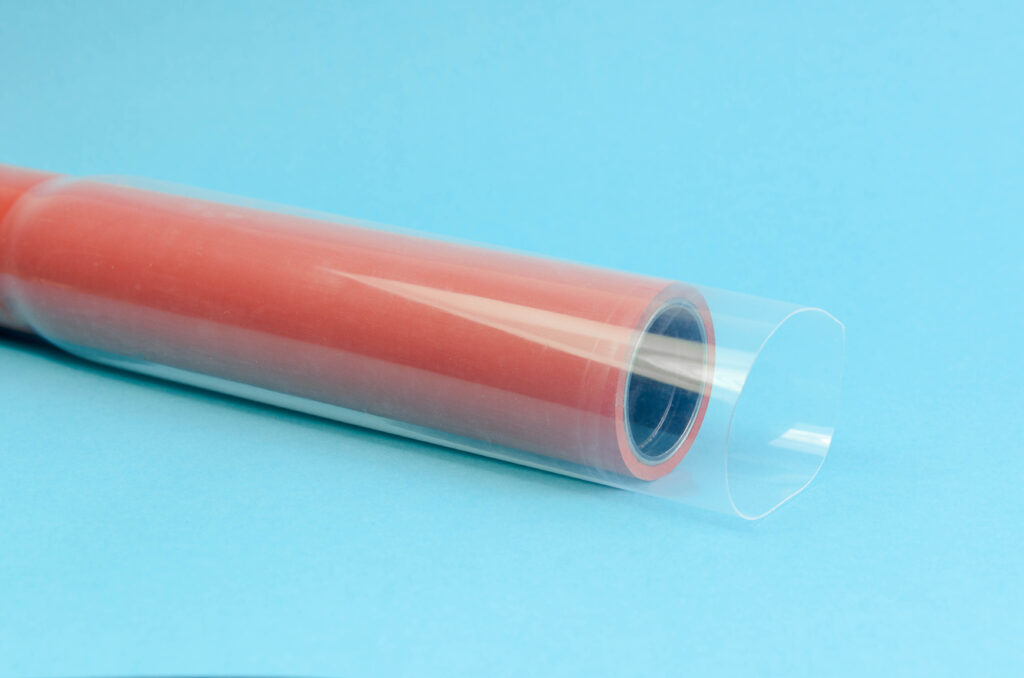
Fluoropolymer films are optically clear, enabling instant visual detection of leaks, weeping fittings or colour changes. In secondary containment, clarity speeds inspections; in primary containment, it supports visual checks without opening the package. - Low surface energy, easy to keep clean
Smooth, non-stick surfaces resist residue build-up and make wipe-downs straightforward—ideal for cleanroom or controlled environments. - Thermal stability
Serviceable across wide temperature ranges (process areas, cold rooms, warm utility zones) with predictable mechanical behaviour. - Low outgassing and low extractables
Important when you’re protecting sensitive materials, preventing cross-contamination, or preserving sample integrity. - Flame retardance
Inherent properties support safer use in facilities with strict EHS requirements.
Two core uses: secondary and primary containment
1) Secondary containment with clear leak indication
For high-value or hazardous liquids, a clear fluoropolymer bag used as an over-cover or jacket delivers rapid visual leak detection. Typical scenarios include:
- Drum and IBC over-bags during storage or transfer, so any seepage from bungs, sight glasses or valves is immediately visible.
- Tank or pump enclosures during commissioning or after maintenance to confirm integrity before full release to service.
- Mobile spill assurance when moving containers across site; a clear secondary layer reduces risk during transit between areas.
Because Holscot bags are clear, operators can spot moisture beads, discolouration or vapour film without disturbing the setup—speeding interventions and reducing clean-up scope if something starts to go wrong.
2) Primary containment for “nasty” or sensitive materials
When the bag is the first line of defence, material choice matters. Fluoropolymer bags are used for:
- Hazardous powders, swabs and evidence items where minimal contamination is essential (e.g., forensic workflows, environmental sampling, QA retains).
- Aggressive chemical samples that would degrade or permeate commodity plastics.
- Cleanroom component protection, where low outgassing and cleanliness support stringent handling protocols.
For sensitive items, the combination of chemical inertness and smooth, cleanable surfaces helps maintain integrity from collection to analysis or disposal.
Standard sizes – and made to measure
We routinely supply:
- Small formats: 200 mm × 200 mm up to ~500 mm square for samples, swabs, components and small assemblies.
- Large/oversize formats: Up to 2 m × 2 m for drum/IBC over-bags, equipment shrouds and temporary process enclosures.
Beyond those, we fabricate custom sizes to your exact dimensions. If you already use a specific footprint, we’ll match it. If you’re designing a new containment step, our team can recommend clearance allowances and film gauges to balance robustness with flexibility.
Closure & handling options
Your process dictates how the bag needs to open, close and be handled. We offer:
- Heat-seal edges and necks (for permanent closure or validated primary containment).
- Adhesive or mechanical closures (clips or ties) for secondary containment where re-entry is required.
- Reinforced hanger holes or tabs for suspending over valves and fittings.
- Gussets and flat bottoms to stand the bag in place during filling or to accommodate fittings.
- Port sleeves (formed fluoropolymer collars) for instrument access or venting while maintaining containment.
- Batch labelling areas compatible with your identification system.
If you run validated procedures, we can standardise features and document the build spec so each replenishment run matches your SOP.
Material selection: FEP, PFA or ETFE?
- FEP (Fluorinated Ethylene Propylene)
Excellent optical clarity, chemical resistance and a very smooth surface. A strong all-round choice for leak-detection over-bags and clear primary containment where inspection is frequent. - PFA (Perfluoroalkoxy)
Similar chemical resistance to FEP with higher temperature margin. Useful where bags may see elevated temperatures or repeated thermal cycling. - ETFE (Ethylene Tetrafluoroethylene)
Tough and abrasion-resistant with good chemical performance. Suited to larger enclosures and areas with greater handling wear, while still providing good visibility.
We’ll help you pick the right polymer and film thickness based on contents, handling, environmental conditions and your inspection regime.
Implementation guidance: making containment practical
- Define the duty
What are you containing (chemistry, hazard class), for how long, at what temperatures, and who will handle it? - Choose size and gauge
We’ll recommend a film thickness that delivers the right puncture resistance without making large bags unwieldy. For secondary containment, allow clearance around fittings and protrusions. - Select closure method
For primary containment, heat-seal is preferred; for secondary, a reusable closure may be more practical. - Plan identification
Clear bags enable visual checks—pair that with bold labelling zones so contents and status are unambiguous. - Pilot and train
Trial the bag in real conditions. We can supply sample runs so your EHS/QA teams can validate usability, sealing and inspection steps before rolling out.
Typical sectors & scenarios we support
- Chemical manufacturing & blending: Clear over-bags for drums/IBCs to spot leaks early and simplify incident response.
- Pharma & biotech: Low-outgassing, clean fluoropolymer bags for component protection and sample containment.
- Forensics & environmental labs: Primary containment with minimal contamination risk for swabs, powders and sensitive items.
- Food & beverage / hygiene-critical sites: Secondary containment to prevent cross-contamination during maintenance or changeovers.
- Aerospace & electronics: Clean handling of parts and assemblies where residues and extractables must be tightly controlled.
For more examples of outcomes in regulated environments, see Holscot’s case studies.
Quality, documentation and repeatability
Holscot is set up for repeatable fabrication with:
- Traceable materials and batch records.
- Consistent welding/heat-sealing procedures for dependable seams.
- Clean handling and packaging to suit your area introduction requirements.
- Call-off and scheduled deliveries to align with shutdowns and production cycles.
If you operate under specific standards (e.g., GMP, ISO cleanroom classes, internal EHS), we’ll align our documentation so your audits run smoothly.
Why choose Holscot for chemical resistant bags?
- Fluoropolymer specialists: Decades working exclusively with FEP, PFA and ETFE across demanding, regulated industries.
- Made to your process: From 200 mm × 200 mm lab bags to 2 m × 2 m + equipment enclosures—with closures, ports and features matched to your SOPs.
- Clarity you can trust: True optical clarity for faster inspections and confident leak detection.
- Engineering support: Practical advice on film gauge, seam geometry and handling to make day-to-day use simple and safe.
Talk to Holscot
If you need clear, chemical resistant bags for secondary containment around drums and tanks – or primary containment to protect people, product and evidence – our team can help you specify the right material, size and closure and get samples moving quickly. Want to see real-world results first? Browse our case studies.